|
Chemicals
 Para Methoxy Phenyl Anisic Acid
Para Methoxy Phenyl Anisic Acid
CAS NO. 89-41-8
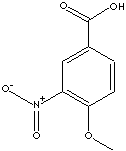
PRODUCT IDENTIFICATION
CAS NO. 89-41-8
4-METHOXY-3-NITROBENZOIC ACID
EINECS NO. 201-906-0
FORMULA C8H7NO5
MOL WT. 197.15
H.S. CODE 2916.39
TOXICITY DERIVATION
SYNONYMS 3-Nitro-p-anisic acid;
3-Nitro-p-anissäure (German); ácido 3-nitro-p-anísico (Spanish);
Acide 3-nitro-p-anisique (French); 5-Carboxy-2-methoxynitrobenzene;
CLASSIFICATION
PHYSICAL AND CHEMICAL PROPERTIES
PHYSICAL STATE
White to pale yellow crystalline powder
MELTING POINT 192 - 194 C
BOILING POINT
SPECIFIC GRAVITY
SOLUBILITY IN WATER Insoluble
AUTOIGNITION
VAPOR DENSITY
VAPOR DENSITY
NFPA RATINGS Health: 1; Flammability: 0; Reactivity: 0
REFRACTIVE INDEX
FLASH POINT
STABILITY Stable under ordinary conditions
APPLICATIONS
Anisole is one of the simplest ether containing aromatic group. But
it is different with aromatic compounds like furan where the oxygen
is a part of the ring. Anisole, C6H5OCH3 (methyl phenyl ether), is a
clear liquid that is soluble in ether and alcohol; insoluble in
water; boiling point 155 C. Anisole and its derivatives are used as
solvents and in perfumery.
Anisole can be obtained from anise seed. Anisic acid, p-methoxybenzoic
acid, is a part of cresol class antiseptic compounds. It is also
used as an insect repellent and ovicide. Anisole, anisic acid, and
their deivatives are also widely used in chemical reaction as
intermediates to obtain target materials such as dyes,
pharmaceuticals, perfumes, photoinitiators and agrochemcials.
Nitro- is the prefix indicating presence of the group -NO2.
Historically They are abundant in dyes and explosives. Nitro
compounds, organic hydrocarbons having one or more NO2 groups bonded
via nitrogen to the carbon framework, are versatile intermediate in
organic synthesis of;
* Michael addition
* Reduction
* Henry Reaction (Nitro-aldol reaction)
* Nef reaction
* O-Alkylation
* Cycloaddition
* Substitution, Elimination, Conversion reaction
* Alkylation, Acylation, and Halogenation
APPEARANCE
White to slightly yellow crystalline powder
ASSAY (GLC)
99.0% min
LOSS ON DRYING 0.2% max
MELTING POINT
183 C min
TRANSPORTATION
PACKING 50kgs in Fiber Drum
| |
|
Note /Government
Notification: These chemicals are designated as those that are
used in the manufacture of the controlled substances and are
important to the manufacture of the substances. For any (Control
Substance) products Import and Export *** subjected to your
country government laws /control substance ACT.
Information: The information on this web page is provided to
help you to work safely, but it is intended to be an overview of
hazards, not a replacement for a full Material Safety Data Sheet
(MSDS). MSDS forms can be downloaded from the web sites of many
chemical suppliers. ,also that the information on the PTCL
Safety web site, where this page was hosted, has been copied
onto many other sites, often without permission. If you have any
doubts about the veracity of the information that you are
viewing, or have any queries, please check the URL that your web
browser displays for this page. If the URL begins "www.tajapi.com/www/Denatonium
Benzoate.htm/" the page is maintained by the Safety Officer in
Physical Chemistry at Oxford University. If not, this page is a
copy made by some other person and we have no responsibility for
it.
The Controlled Substances Act (CSA) was enacted into law by the
Congress of the United States as Title II of the Comprehensive
Drug Abuse Prevention and Control Act of 1970.[1] The CSA is the
federal U.S. drug policy under which the manufacture,
importation, possession, use and distribution of certain
substances is regulated. The Act also served as the national
implementing legislation for the Single Convention on Narcotic
Drugs |
|
|
 |








 India
India
 ©
2004 - 2019
Taj Pharmaceuticals Limited
. All rights reserved
©
2004 - 2019
Taj Pharmaceuticals Limited
. All rights reserved